

Voices That Insist on Surviving
A collection that speak to human dignity and the art of bearing witness

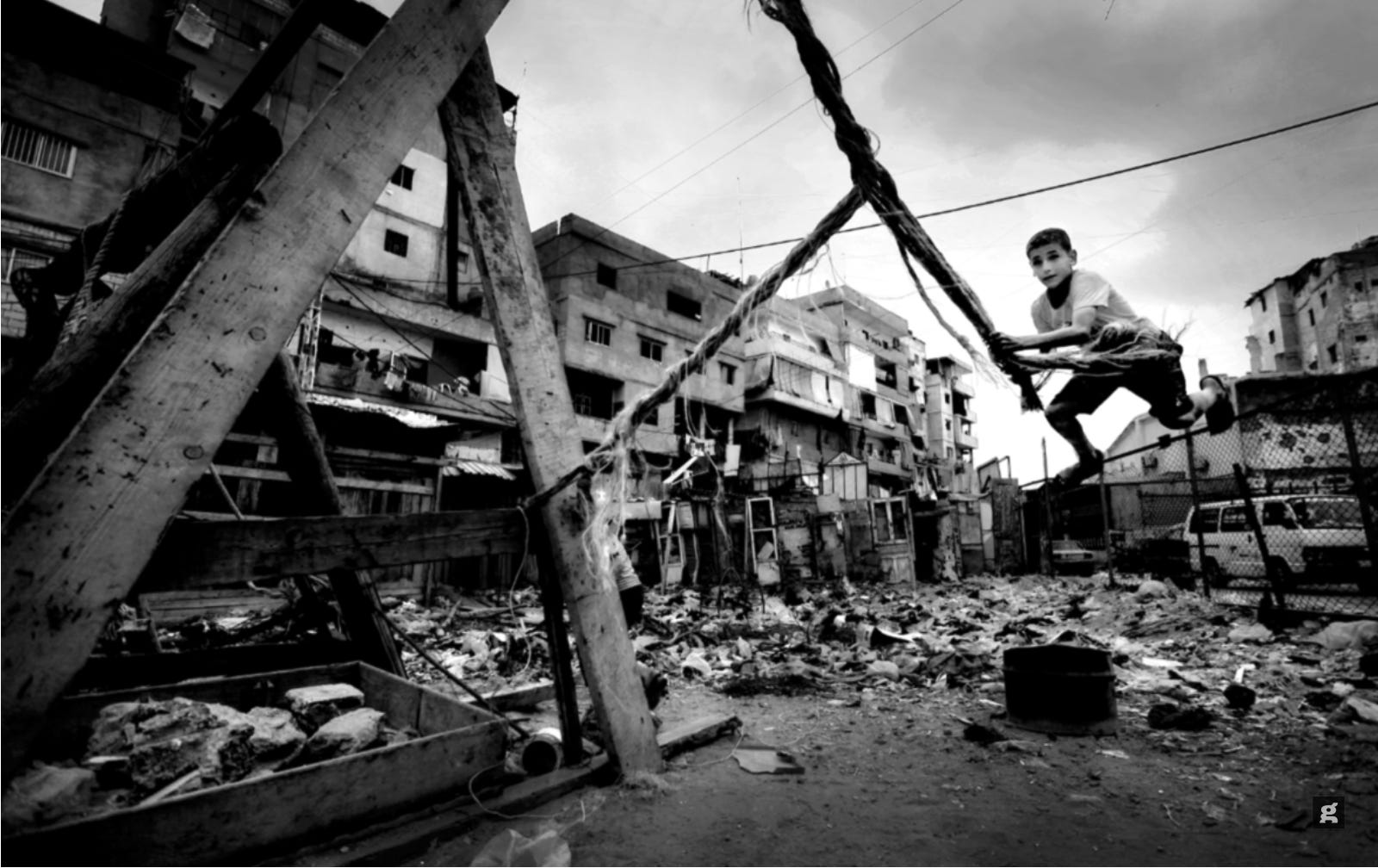
I’ve been thinking a lot lately about what it means to bear witness—not just as a documentarian with a camera, but as human beings trying to make sense of suffering too large to comprehend. Something happens when individual voices rise from impossible circumstances, refusing to disappear quietly into statistics or silence.
It started with a question I couldn’t shake: How do some voices travel across distance, across time, across the noise of everything else demanding our attention? What makes certain calls for help echo long after the immediate crisis has passed?
These four fragments found their way into my collection because each answers that question differently: a child’s phone call from Gaza, photographs from 1960s Brooklyn, a French historian’s reflections on testimony, and fresh graffiti on a London wall. Separated by decades and geography, they are connected by the essential insistence of human dignity: to be seen, heard, and remembered.
The Call That Echoes
Some voices rise from places we cannot reach. In Gaza, six-year-old Hind spent three hours on the phone with emergency dispatchers, trapped in a car surrounded by the bodies of her relatives. Her small, steady, impossibly brave voice cut through fear:
"Come and take me. Will you come and take me? I'm so scared, please come and take me."
The rescue team sent to find her was killed en route. Hind was found weeks later.
Her story has now been transformed into cinematic testimony through The Voice of Hind Rajab, directed by Kaouther Ben Hania and executive produced by Brad Pitt, Joaquin Phoenix, and Alfonso Cuarón. When the film premiered at the 2025 Venice Film Festival, it received a 23-minute standing ovation and won the Grand Jury Prize.
When Words Fail, Images Speak
Leonard Freed, Brooklyn, 1960s
When calls go unanswered, something else emerges: the human need to document, to witness, to transform pain into something that can be held and remembered.
Freed walked through Brooklyn with his camera as a divining rod, finding dignity in doorways and defiance in direct gazes. His photographs connect directly to Hind’s story. Both are forms of testimony. Both insist on presence. The photograph becomes a rescue mission that arrives too late, yet exactly on time.
The Long View
Henri-Irénée Marrou, 1904–1977, Historian
Individual voices and artistic responses are molecules of something larger. Marrou studied early Christian testimonies and understood that every document is a message in a bottle, thrown across time by someone who needed to be remembered. Survival, he observed, isn’t just biological—it’s cultural, spiritual, testimonial.
The voices that echo loudest are often those spoken from the edge of extinction. Hind’s phone call and Freed’s photographs—they are all messages across space and time, each insisting on being remembered.
Watch this archival footage of Marrou discussing Saint Augustine:
Filmed at the ancient ruins of Tipasa, Algeria
Today's Walls
Banksy, London, September 2025
Somewhere in the world, a new mural appears overnight. Outside London’s Royal Courts of Justice, Banksy depicted a protester struck by a judge’s gavel. For a brief moment, the wall becomes a stage of testimony: raw, shocking, impossible to ignore.
Each act of defiance reminds us that to exist with dignity—and to speak truth to power—is itself an act of courage.
The Collection Continues
What I’ve been gathering are fragments that speak across time and space: a child’s voice in Gaza, photographs from 1960s Brooklyn, ancient historians, anonymous street art. These connections are not random; they are building blocks of dignity, testimony, and witness. Each fragment is a doorway, and together they tell a story—not of triumph or tragedy, but of persistence. Of the refusal to disappear quietly. Of art as an emergency signal. Of dignity as the most radical act.
Algerian singer Souad Massi understood this when she recorded Raoui (The Storyteller) in 2001: “Oh storyteller, tell us a story… make us forget this time, leave us at once upon a time.” Her plea reveals something deeper: when the present is unbearable, stories are not just comfort—they are survival.
This Catalog is an invitation to pay attention. Bearing witness is not only the work of documentarians or artists—it is what we all must do in the face of silencing: to defend dignity, to resist erasure, and to affirm humanity.